On this page:
- Research and Instruction
- Course Reserves
- Interlibrary Loan
- Purchase Requests
- Scholarly Communication and Research
Research and Instruction
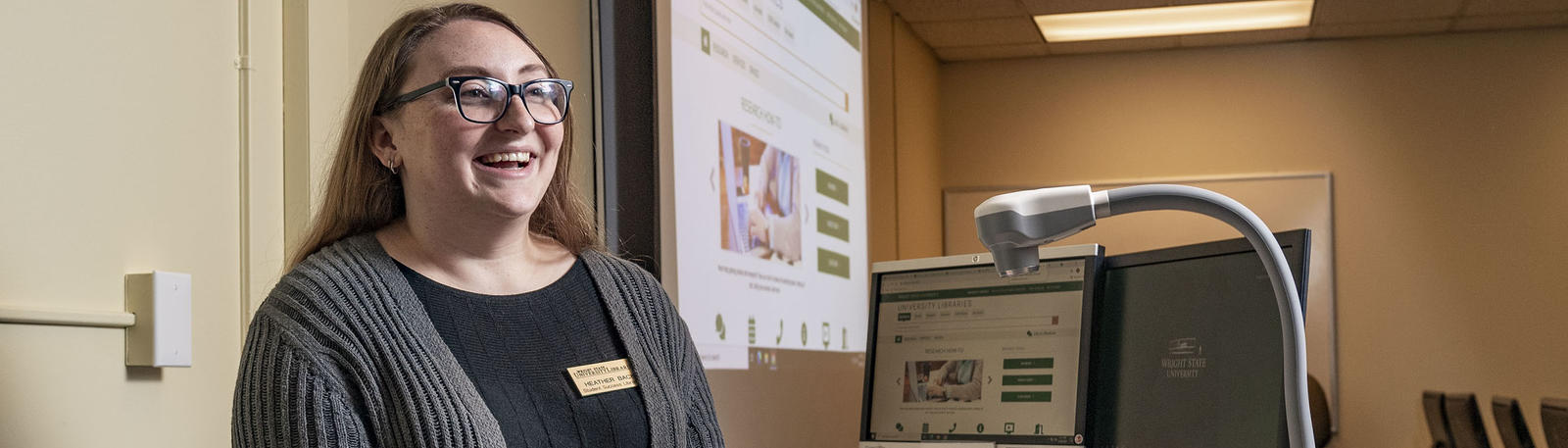
Subject librarians are committed to faculty and student success. Each Wright State academic program has an assigned subject librarian whose work can support faculty research and instruction. Sample services include:
- Literature searches
- Database search strategies
- Journal advice for manuscript submissions
- Research alerts based on topic or author
- Cooperative collection development
- Develop new library research assignments
- Create course-specific library guides
Services for your students:
- Customized library instruction sessions by topic or skill
- Tours and orientation sessions
- Critical evaluation of research sources
- Personalized research instruction through appointments
- Efficient use of library databases
Schedule an appointment or contact your subject librarian to ask about any of these services or request a library instruction session.
Learning to do academic research is one of the biggest challenges facing college students. We have online tools to help students meet the challenge.
- How-to Guides - short introductions to help navigate library resources
- Research Toolkits - skill-based tutorials to help students find, evaluate, and integrate academic literature
Course Reserves
Course Reserves are materials designated by faculty or staff for use by students in a specific course; they include books, AV, textbooks, class notes, sample solutions, personal copies, or any physical item you wish your students to share. Print reserves collection can be restricted by location (in-library only) or by loan period. Please allow two weeks to process start-of-semester reserves.
Interlibrary Loan
The Interlibrary Loan department provides free electronic document delivery services for all Wright State faculty (a service not available to staff or students). We can provide a URL to the requested article, a PDF document or printed copy of an article, and delivery to your office through campus mail.
Purchase Requests
The University Libraries partners with faculty to build a library collection that supports teaching, learning, and research in all Wright State programs. Use our New Materials Purchase Request form to request materials to be added to the collection. The library purchases a variety of materials in differing formats including books, e-books, DVDs, streaming media, audio, and more.
Scholarly Communication and Research
CORE Scholar
CORE Scholar is Wright State University’s open access institutional repository managed by the Libraries that collects and makes available the scholarly output of Wright State faculty, staff, and students, as well as local, regional, and Wright State heritage material.
We can:
- Publish research, books, and scholarly works
- Publish open access journals
- Create and manage conferences or events and publish proceedings
Consider contributing articles, e-prints, preprints, statistical and geospatial datasets, technical reports, visual and scientific images, working papers, conference papers, audio/video files, electronic publications, and more.
Researcher Profiles
Wright State's Researcher Profiles showcases the research of Wright State faculty members and the university as a whole. The system:
- Connects faculty members to facilitate interdisciplinary research
- Connects students with current research projects
- Displays faculty research to a worldwide audience
Researcher Profiles is composed of individual faculty profile pages, created and maintained by library staff.
Protecting Your Rights as an Author
Librarians can help you protect your rights by providing training and assistance with identifying and avoiding predatory publishers who mimic open access journals and publishers in order to prey on researchers. Knowing your rights as an author of a scholarly article is an important and often overlooked first step in the publishing process. We can help you:
- Identify and avoid predatory publishers who mimic legitimate open access journals
- Use SHERPA/RoMEO to learn about publishers' use policies after publication, including summaries of self-archiving permissions and conditions of rights given to authors
- Understand publisher agreements that transfer copyright from your work to them and limit your ability to use, share, and distribute your work
- Learn about statements you can include to retain your rights, as well as other methods and resources